
APEX, through its STTR partnership with UNDTL, AFRL, and AEDC, is engaged in developing a test-ready data acquisition solution for hypersonic testing, including improvements in modeling, simulation, and video and measurement integration. The collaboration also addresses technical questions regarding whether freejet or direct connect testing will be more effective for advancing next-generation hypersonic technologies. By uniting visionary minds and state-of-the-art facilities, this collaboration seeks to redefine how we validate, compare, and advance hypersonic propulsion technologies—and sets the stage for a new era of high-speed innovation. By directly exploring the unique capabilities of both direct connect and freejet test methods, our interdisciplinary team aims to understand the distinct advantages each approach offers. Together, we’re working to set new benchmarks for how we validate and advance high-speed flight technologies.
At the heart of this effort are two pivotal onsite tests scheduled to rigorously validate and compare hypersonic test methodologies. The first test will take place at UNDTL’s direct connect facility, utilizing a system-level approach to engine integration and performance diagnostics. The second is set for AEDC in collaboration with AFRL, leveraging the unique capabilities of Tunnel D—a premier freejet test facility. Together, these tests form the core of our mission: to probe the strengths and limitations of direct connect and freejet approaches for advancing the state of hypersonic vehicle development.


This STTR program is not merely about demonstration, but about refining and updating the framework for hypersonic validation. By conducting parallel, highly instrumented tests at both direct connect and freejet facilities, APEX and our partners seek to answer a fundamental question: does the choice of test method materially impact the quality, relevance, and efficiency of hypersonic ground test data? The findings will inform future facility investments and provide customers with actionable insights into optimal test strategies for their specific needs.
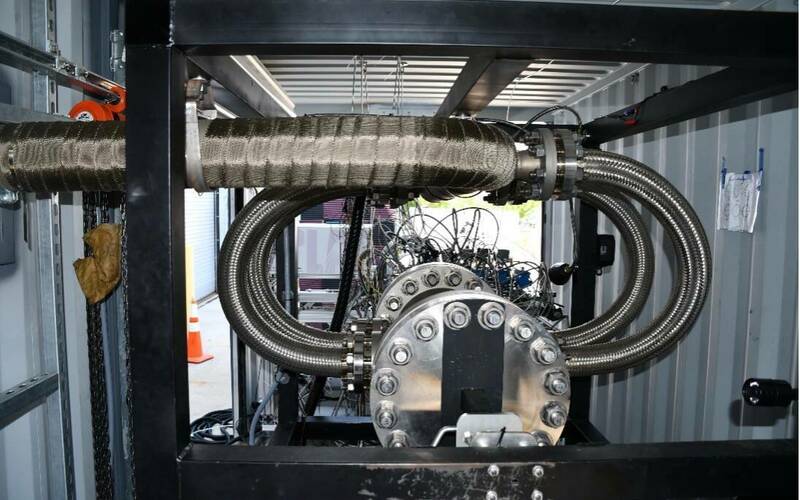
A direct connect approach streamlines the simulation of hypersonic propulsion by channeling high-enthalpy, high-velocity gas directly into the inlet of the test article. The UNDTL facility is specially equipped to deliver tailored flow conditions, allowing precise control of pressure, temperature, and gas composition to match mission-specific flight points
Key Features:
· Direct inlet coupling enables accurate assessment of engine internal
flowpaths, combustion stability, and thermal management.
· Minimized test cell effects reduce facility-induced noise, supporting high-fidelity measurements of ignition, flameholding, and steady-state operation.
· Instrumentation suites include high-bandwidth pressure sensors, heat flux gauges, and exhaust composition analyzers for comprehensive diagnostics.
Pros:
· Highly repeatable and controllable test conditions.
· Efficient for rapid technology screening and engine characterization.
· Reduced facility startup transients and test noise.
Cons:
· Does not replicate external aerodynamic effects such as boundary layer growth, shock impingement, or shear layer development.
· Potentially less flight-representative for integrated vehicle/airframe studies.
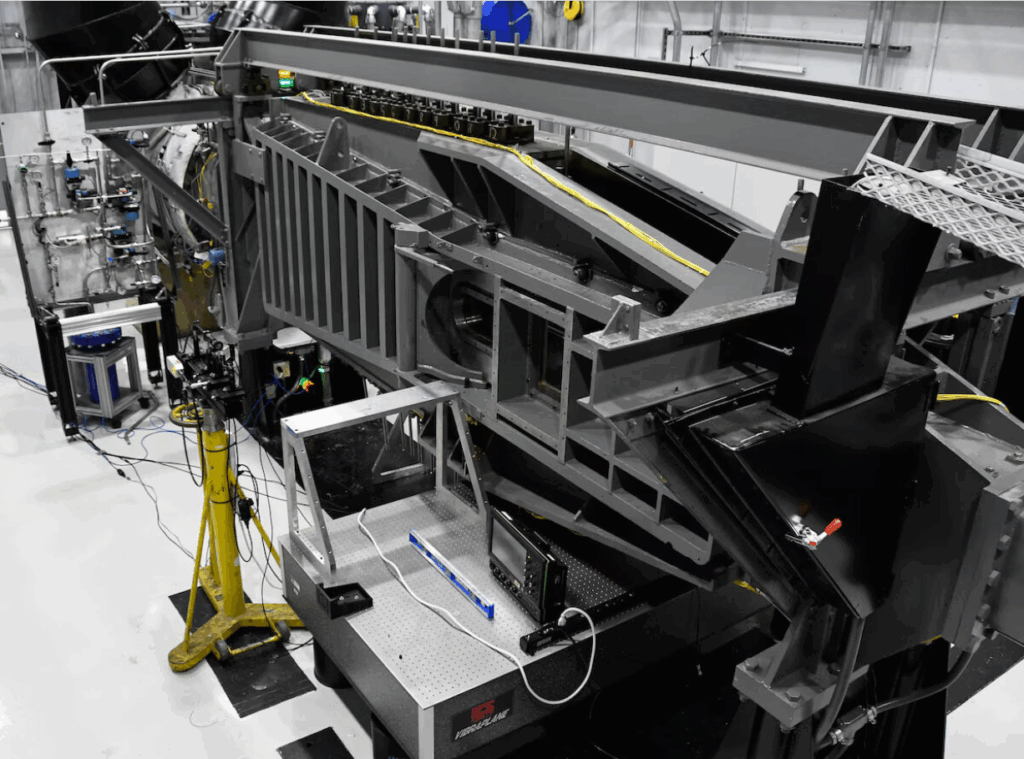
The freejet methodology, as employed at AEDC Tunnel D, strives to recreate the true flight environment by producing a high-speed, high-enthalpy stream of gas that expands through a meticulously designed nozzle. The test article is positioned in the core of this jet, experiencing genuine external flow phenomena.
Key Features:
· Reproduces external aerodynamic effects: shock/boundary layer interactions, flow separation, and startup transients.
· Critical nozzle-to-model distance calibration ensures uniformity and minimizes boundary layer interference.
· Advanced visualization and surface diagnostics (e.g., schlieren imaging, pressure-sensitive paint, thin-film gauges)
Pros:
· Flight-representative environment for coupled aerothermal/aero-propulsive studies.
· Essential for validation of integrated vehicle performance and control.
· Captures complex flow physics and facility-induced phenomena
relevant to operational scenarios.
· Ability to dynamically change vehicle angle (AoA) and test varying
conditions surrounding the article.
Cons:
· Higher facility noise and startup transients increase data analysis complexity.
· Greater operational complexity and test article integration challenges.
· Lower throughput, longer setup and cycle times.
This dual-test campaign provides an invaluable side-by-side evaluation of direct connect and freejet methodologies under coordinated test conditions. Our objective is to present potential customers with clear, data-driven guidance on which approach best suits their technology development phase, risk profile, and budget.
Direct connect offers excellent control and efficiency for engine core maturation, making it ideal for early-stage systems and rapid iteration. Freejet, on the other hand, enables validation of integrated vehicle performance under realistic flight-like conditions—critical for system certification and mission assurance. By rigorously quantifying the technical tradeoffs, APEX and its STTR partners empower the hypersonics community to make informed, value-driven decisions.