

Kurt Nichol started APEX in 2000 as a way to bring the cutting-edge technology he was working on at Pratt & Whittney and the Airforce to the private sector. Since then, he’s been instrumental in developing standards and best practices for Aeromechanics and HCF, and has helped many top OEMs find engineering success with specialized software – in aeromechanics and beyond. After 25 years of successful business, we wanted to talk to him about some history, highlights, and horizons from his perspective as APEX Founder and CEO.
KURT: I started EDAS/APEX in August of 2000 out of a desire to do something bigger with my career. I had spent nearly twenty years between Pratt & Whitney and the Arnold Engineering Development Complex (AEDC) working in engine test and specifically in high cycle fatigue (HCF) advancing tools and methods which were successful in addressing the problem. I can remember looking out the window of my office and thinking that I didn’t want to get to the end of my career and wonder what might have been had I taken a risk. I had the idea that perhaps the tools and techniques we had developed over the years might be commercially marketable. My original idea was to continue to work through my then-current employer, Sverdrup Technology, to spin off the technology as a new venture there. After a lot of discussion with the leadership there as well as the US Air Force, it made more sense for everyone involved to spin off a new company entirely, and so, with their blessing and a Cooperative Research and Development Agreement (CRDA) which granted us official access to the technology, I created Experimental Design and Analysis Solutions with Csaba Biegl to market HCF technology to the private sector. In 2015, we changed the name of the company to APEX Turbine Testing Technologies.

KURT: Without a doubt, the most important relationships for our company were the many, many contacts I had made with engineers at the various companies that tested at AEDC. These relationships became our eventual customer base and without that, there is no business! Secondly, all the people at AEDC that contributed to the development of the technology we were to market played a vital role. That especially included Csaba who wrote much of the computer code we would eventually sell. But aside from the business aspects, the biggest contributor to the success of the company has been my wife, Linda. I can remember coming home from work one day to her and our three very young children and telling her that I wanted to quit my safe, secure job and start a company. Her reply was simply, “Ok, I believe in you.” And she’s been a constant encouragement ever since.
KURT: Success has many facets. At the most basic level, success is being able to eat every day and live indoors. APEX has been blessed to make payroll every time and to generate a profit every year for 25 years now. Providing for my family and the families of my employees has been a huge success all these years and is something I take very seriously. I also consider it a huge success to have operated the company with integrity for my entire tenure. I’ve never compromised my values for the sake of profit or convenience and we’ve always stood behind our products for the sake of our customers and have always cared for our employees first. This is very important to me as it reflects on my faith and my God. I’ve always considered that God is the ultimate owner of the company and that I’m just his steward. Finally, success is also defined by the impact the company has made in our market. I don’t think it’s an overstatement to say that many, if not most propulsion systems current flying today were tested and qualified using our products. I take pride in knowing that we contribute to the safety of the flying public and the readiness of our military through the work we do at APEX.
KURT: That’s an interesting question because I had very little to do with the execution of any of the projects we’ve worked. My role has always been more along the lines of defining what we should work on. The staff gets credit for execution. Having said that, I do take pride in my participation in providing training and consultation to our customers on better ways to do things and the impacts we’ve made on many of the systems that were tested using our products. I think I’ve personally worked in one way or another on just about every propulsion system in the US military and many commercial platforms, and that’s been fun for me.
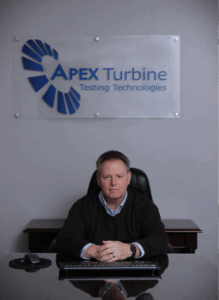
KURT: I’ve been deliberately working on preparing people in our company to be the next generation of leaders. I’m getting closer and closer to retirement and as I do, the most important thing I can do is get the company ready to run without me. In addition to preparing new leaders to take over, it’s vitally important that the products we sell appeal to a broader market and position the company for growth. We made a deliberate decision to create a whole new technology platform for our products that would enable us to take better advantage of new computer capabilities. This has been a vital step to ensure our future success.
KURT: I think APEX is being positioned now to be a major player in testing and development of advanced technology systems that extend naturally beyond our heritage in turbomachinery. I can see a future where APEX products greatly benefit the hypersonics, space, and energy markets. This includes all kinds of vehicles, industrial complexes, universities and labs around the world. But for me, my legacy will be the people that I was able to impact both personally and professionally. I hope future generations will think of me as a man of faith, who worked hard to make the world just a little bit better every day.